
SEO vs AEO vs GEO vs AIO: Understanding the Future of Digital Optimization
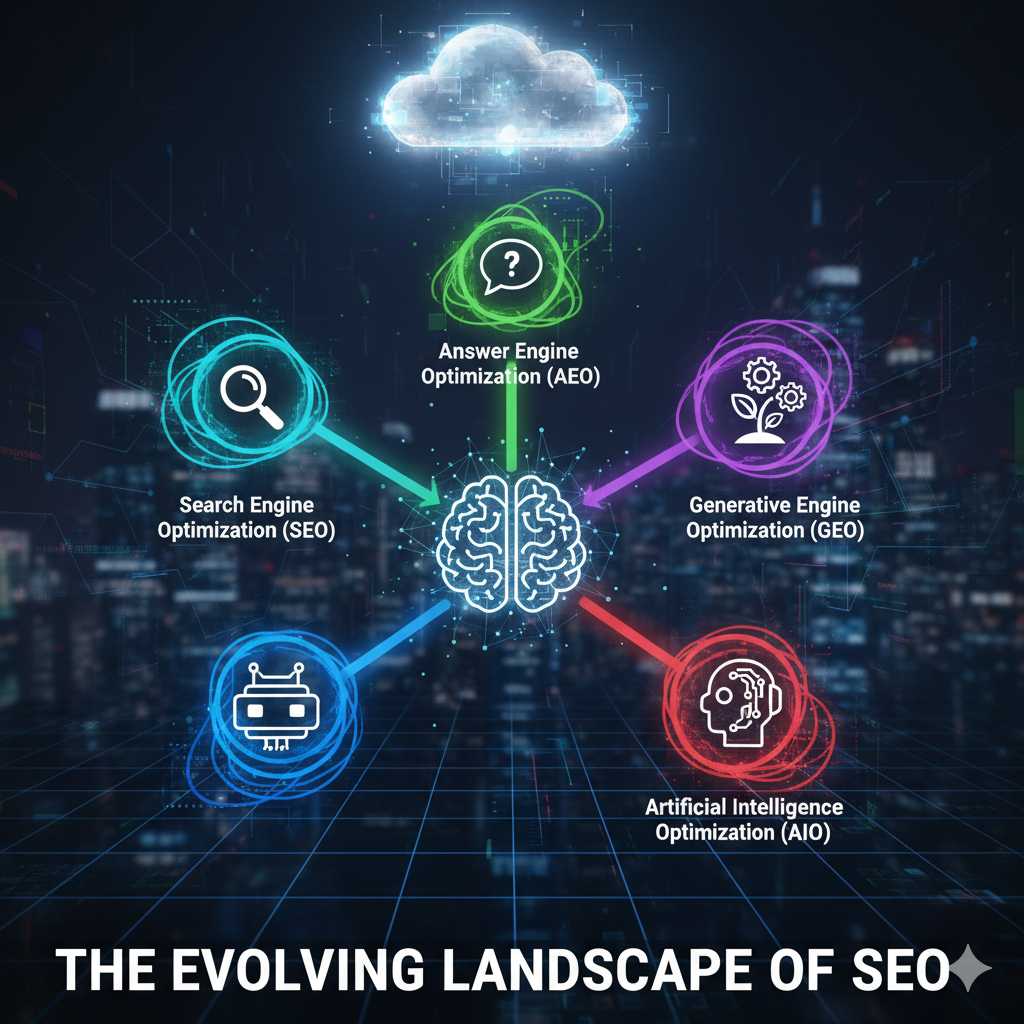
In today’s digital-first world, businesses and brands constantly compete for attention online. Traditionally, Search Engine Optimization (SEO) has been the gold standard for visibility. But with the rise of AI-driven technologies and conversational platforms, new forms of optimization are emerging — Answer Engine Optimization (AEO), Generative Engine Optimization (GEO), and Artificial Intelligence Optimization (AIO).
Let’s break down what these mean, how they differ, and why they matter for the future of online visibility.
Digital marketing is evolving faster than ever. Marketers who have long relied on Search Engine Optimization (SEO) now hear new terms everywhere: Answer Engine Optimization (AEO), Generative Engine Optimization (GEO), and Artificial Intelligence Optimization (AIO).
The problem? Many confuse these new concepts, thinking they’re just another version of SEO. But in reality, each serves a different purpose.
Let’s break it down clearly with examples and processes.
Search Engine Optimization (SEO)
What it is:
SEO is about optimizing your website to rank in search engines like Google.
Typical SEO Process:
Keyword Research – Brainstorming, auto-suggestions, related keyword searches, competitor analysis, and tools like Google Keyword Planner.
On-Page Optimization – Title tags, meta descriptions, header tags, keyword placement.
Content Strategy – Blog posts, landing pages, FAQs targeting the chosen keywords.
Technical SEO – Site speed, mobile friendliness, structured data, crawlability.
Off-Page SEO – Backlinks, brand mentions, social signals.
Definition:
SEO is the process of optimizing websites and content to rank higher on search engines like Google, Bing, or Yahoo. It involves strategies such as keyword optimization, link building, technical SEO, mobile friendliness, and content relevance.
Current Role:
Even with the rise of AI, SEO is far from dead. In fact, it still forms the foundation of digital visibility. Search engines are evolving, but they still rely heavily on optimized content to deliver results. Without SEO, businesses risk being invisible in organic searches.
Goal Of SEO
To drive organic traffic from search engines by ranking higher in SERPs.
__________________________________________________________________________________________________________________________________________________________________________
Answer Engine Optimization (AEO)
Definition:
AEO focuses on optimizing content so it can be directly used as answers in platforms like Google’s featured snippets, Bing’s AI chat, or voice assistants like Siri, Alexa, and Google Assistant. Instead of driving users to click on a link, AEO ensures your content becomes the answer itself.
Example:
When someone asks, “What is the capital of France?” and the search engine responds directly with “Paris”, that’s the power of AEO.
Benefits of AEO:
Higher brand visibility through position zero and AI-driven responses.
Increased trust and authority since your brand becomes the source of truth.
Better performance in voice search and conversational AI.
What it is:
AEO is about structuring your content so search engines and voice assistants can pull direct answers to user queries. Instead of just ranking, your goal is to become the answer.
How it’s Done (AEO Process):
Identify Questions – Use tools like AnswerThePublic, People Also Ask (Google), or Quora.
Create Q&A Format Content – Short, precise, conversational answers.
Use Structured Data (Schema Markup) – FAQ schema, how-to schema, etc.
Optimize for Voice Search – Natural, conversational language.
Example:
User asks Siri: “What is digital marketing?”
→ AEO ensures Siri reads out your site’s answer instead of just listing websites.
Goal Of AEO
To win featured snippets, voice search, and AI-chat answers.
___________________________________________________________________________________________________________________________________________________________________________
Generative Engine Optimization (GEO)
Definition:
With the rise of generative AI (like ChatGPT, Perplexity, or Bard), GEO is about making content discoverable and usable by AI-powered engines. These platforms generate responses by pulling insights from across the web, so optimizing for them means structuring content that AI can easily interpret, summarize, and cite.
Example:
When ChatGPT gives a summarized list of “best marketing strategies,” GEO ensures your brand or content appears in that generated output.
Benefits of GEO:
Ensures visibility in AI-driven conversations.
Boosts the chance of being cited or referenced by generative models.
Helps brands stay relevant as AI search gradually replaces traditional browsing.
What it is:
GEO focuses on how AI engines like ChatGPT, Perplexity, or Google SGE consume and generate content. Unlike AEO, where you optimize for short factual answers, GEO ensures your brand/content appears in long-form AI-generated responses.
How it’s Done (GEO Process):
Create AI-Friendly Content – Clear structure, well-cited, fact-rich, and up-to-date.
Long-Form Authority – Guides, case studies, original data that AI engines can reference.
Entity Optimization – Make your brand recognized as an entity (Wikipedia, knowledge panels, mentions on trusted sources).
Consistency Across Channels – Publish across blogs, social, and PR for wider AI discoverability.
Example:
A user asks ChatGPT: “Best digital marketing strategies in 2025?”
→ GEO ensures your blog is one of the sources ChatGPT summarizes and cites.
Goal Of GEO
To be part of the AI-generated summaries and recommendations.
___________________________________________________________________________________________________________________________________________________________________________
Artificial Intelligence Optimization (AIO)
Definition:
AIO is a broader practice of optimizing for AI algorithms beyond just search. This includes personalization engines, recommendation systems (like Netflix or Amazon), chatbots, and AI-based social media algorithms. It’s about ensuring your content, products, and brand are aligned with how AI systems learn, rank, and recommend.
Example:
If an AI-powered shopping app recommends your product over competitors, that’s AIO at work.
Benefits of AIO:
Enhances personalization and user targeting.
Positions your brand to be AI-friendly across multiple platforms.
Ensures long-term adaptability as more digital experiences become AI-driven.
What it is:
AIO is the broadest form. It’s not limited to search or generative engines but focuses on all AI-driven platforms: recommendation systems, personalization engines, and AI algorithms that decide what content/products to show.
How it’s Done (AIO Process):
AI Data Training Signals – Creating clean, structured, trustworthy data.
Optimize for Recommendations – Product tagging, descriptive metadata, customer reviews.
Personalization Focus – AI-driven ad campaigns, recommendation-friendly content.
Cross-Platform Optimization – Making sure your content is AI-readable across YouTube, Amazon, Netflix-type algorithms, social media feeds, and chatbots.
Example:
Amazon recommends your product first because its algorithm understands your content, reviews, and structured data better than competitors.
Goal Of AIO
To make your brand more discoverable and recommended by AI across all platforms.
___________________________________________________________________________________________________________________________________________________________________________
Quick Comparison Table
| Optimization Type | Main Focus | Process Example | Final Goal |
|---|---|---|---|
| SEO | Ranking in search engines | Keyword research, on-page, backlinks | Organic traffic |
| AEO | Direct answers in snippets & voice | Q&A content, schema markup | Be the “answer” |
| GEO | Visibility in AI-generated content | Long-form authority, citations | AI mentions & references |
| AIO | Broader AI platforms (recommendations, personalization) | Metadata, structured content, reviews | AI-driven visibility everywhere |