ANDROMEDA: Meta’s Next-Gen Ad Delivery Engine
What Is Andromeda?
At its core, Andromeda is Meta’s upgraded “ads retrieval” engine. This is the phase where Meta selects which ads to consider showing to a user before the final auction. Instead of just relying on simple signals and manual targeting criteria, Andromeda brings in very powerful neural networks and more compute capacity to massively scale and improve how relevant ads are chosen. Engineering at Meta+2Medium+2
Here’s what makes it special:
High Complexity Models: Meta built deep neural networks optimized for NVIDIA Grace Hopper Superchips. This is very compute-heavy and allows very large and expressive models for retrieval.
Hierarchical Indexing: To manage the huge explosion of ad creatives (especially with generative AI), Andromeda uses a hierarchical structure to index ads. This reduces inference cost and improves retrieval speed.
Model Elasticity: The system dynamically adapts to which “segment” of ads it’s serving, using more complex models for high-value segments and simpler ones when appropriate — optimizing resource use.
Low-Latency, High-Throughput: The architecture is built to be very efficient: feature extraction, parallelism, and memory I/O are all optimized to handle a large volume of ads in real time.
In short: Andromeda is not just an incremental tweak — it’s a major reinvention of how Meta retrieves and considers ad creatives for users.
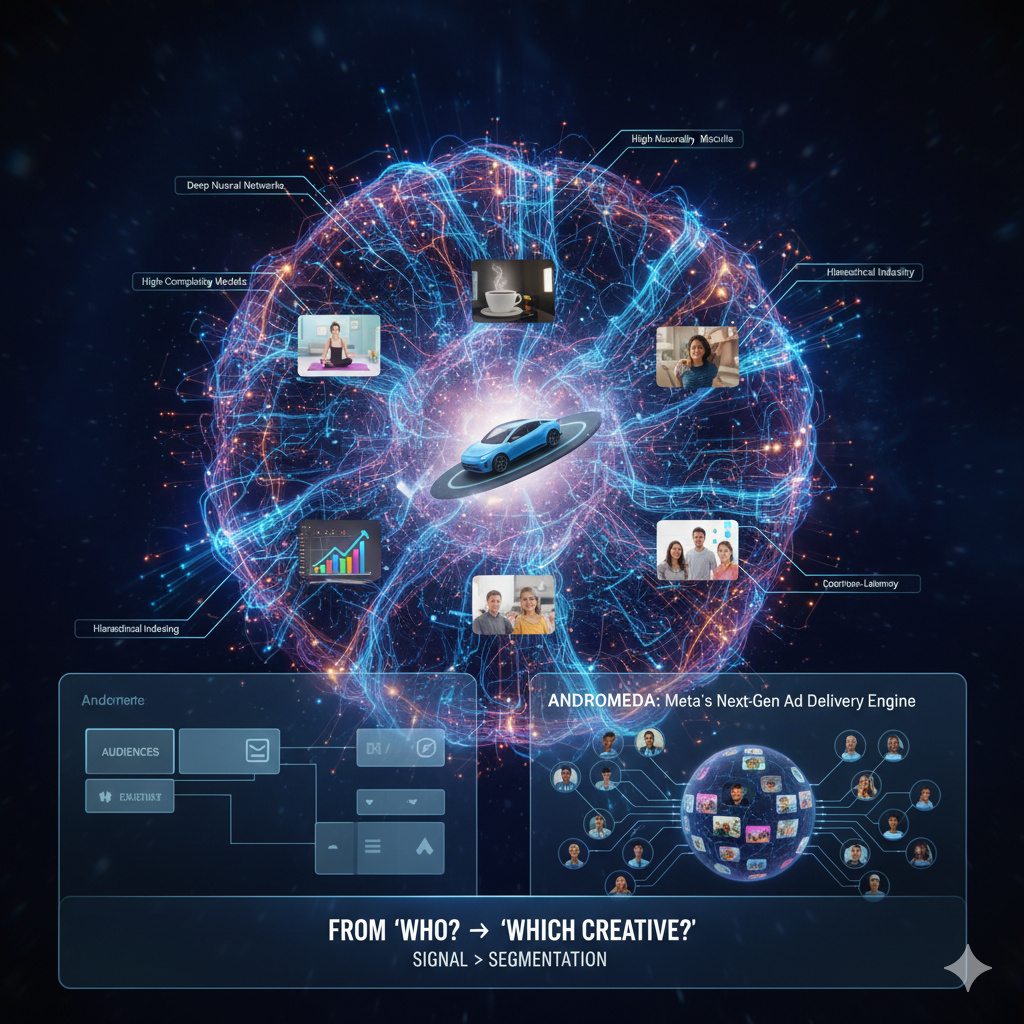
From “Who Should I Show To?” → “Which Creative Should Show?”
Before Andromeda, a big part of ad strategy was about defining audiences. You picked specific demographics, interests, behaviors — that heavily influenced which users saw your ads.
With Andromeda, the balance shifts:
Instead of just asking “who are the right people?”, the system increasingly asks: “which ad creative will resonate most with this particular user?”
The retrieval engine now considers not just targeting, but creative signals (visuals, copy, format, engagement) as first-class inputs.
This means creative quality and variety aren’t just nice-to-have — they are the foundation of how Andromeda decides which ads to pull into the delivery pool.
Key Changes & Concepts Under Andromeda
Here are the major conceptual shifts and how things actually work now — with examples to make it clear.
1. Creative Diversity Becomes Critical
Why it matters: Andromeda’s ML models need rich, varied creative signals to learn what works. If all your ads are too similar, there’s not enough diversity for the AI to detect patterns.
What to do: Instead of just making minor tweaks (like changing a headline or color), create different concepts: story-driven ads, demo ads, UGC, emotional storytelling, product use-case, etc.
Example: Suppose you’re advertising a fitness app:
Ad 1: A motivational story (“How I lost 10 kg”)
Ad 2: A demo (“Here’s how to use this workout plan”)
Ad 3: Social proof (“Thousands of people tried this and saw results”)
Ad 4: UGC-style (“Real users doing real workouts in their homes”)
This variety helps Andromeda match different creatives to different users intelligently.
2. Campaign Structure: Simpler + Bigger Creative Pools
Under older algorithms, many advertisers used micro-segmentation: a bunch of ad sets, each for a narrow audience. With Andromeda:
Simplify campaign structure: Fewer ad sets (even 1) + many creative variations per ad set is now the recommended approach.
Use broad targeting: Let the algorithm explore broadly rather than imposing tight audience splits. 360 OM+1
Leverage Advantage+: Using Meta’s automated tools (like Advantage+ campaigns), which handle placements, bids, and targeting, works very well with Andromeda’s design.
Why this works: Andromeda’s retrieval system can evaluate many ad creatives at once and learn which creative resonates with which micro-segments. If you restrict targeting too much, you starve the system of signal.
3. Creative Volume & Continuous Refreshing
More creatives = more signal: Because Andromeda can handle a large volume of ads, it rewards campaigns that feed it many different creative ideas.
Frequent refresh: Creative fatigue (It’s when an audience sees the same ad too many times, causing them to get bored, tune it out, or even become annoyed. This leads to a drop in the ad’s effectiveness (lower click-through rates, higher cost per acquisition) happens more noticeably now. Winning ads scale quickly but can Fail as they Drop.
Fresh concept generation: Ideally, advertisers should generate new creative concepts regularly, not just tweak old ones.
4. Signal Quality & Data Hygiene
Andromeda thrives on good, clean data and strong signals. Some critical points:
Make sure your pixel and Conversion API (CAPI) are properly set up and sending accurate event data.
Use post-click signals: The system doesn’t just look at clicks; it also considers what happens after the click (time on site, deeper page interactions, return visits).
Engagement matters: Long video watch times, comments, saves, shares — these are valuable signals that the algorithm uses to rank creatives.
Exclude overlapping audiences (e.g., past customers) when necessary, so that Andromeda doesn’t over-optimize toward high-ROI but low-growth segments.
5. Andromeda’s Retrieval + Ranking Architecture
Let me break down how ads are chosen and ranked, in two major stages:
Stage 1: Retrieval
This is where Andromeda shines. From millions of ad creatives, it needs to pick a subset (a few thousand) to consider for a user.
It uses hierarchical neural networks + indexing to do this efficiently.
Ads are evaluated on “how strong is the signal from this creative for this user?” — not just if it matches audience targeting.
Stage 2: Ranking
After retrieval, there’s a ranking step (post-retrieval) where Meta decides which ad to actually show, based on bid, predicted performance, and quality.
Creative relevance (how well the ad matches the user’s predicted interests/intent) is now a critical factor.
There’s an equity/fairness component: high-quality, relevant ads are more likely to be shown, not just the highest bidder.
Strategies to Win Under ANDROMEDA
Putting theory into practice, here are advanced strategies tailored for the Andromeda world:
Creative First, Always
Build “creative packs” per campaign: multiple concepts, angles, formats, and styles.
Think in terms of “creative ideas” rather than just “ad variations.”
Structured Creative Refresh Cycle
Set a rhythm, e.g., refresh or upload new conceptual creatives every 7–14 days.
Track performance not just by CPA/ROAS but by emergence of new winners and creative signal strength.
Simplify Campaign Architecture
Use fewer campaigns and ad sets, but pack in creative diversity.
Leverage broad targeting and automation (e.g., Advantage+) so Meta’s system has more freedom to learn.
Optimize for Signal Quality
Ensure tracking (Pixel, CAPI) is clean, accurate, and sending granular event-level data.
Focus on post-click user behavior (time on site, engagement) and feed that back into strategy.
Monitor & Interpret Creative Performance
Instead of killing underperforming ads immediately, evaluate them for niche performance: low spend doesn’t always mean bad creative; could be a micro-audience.
Pause or remove ads that consistently underperform on engagement metrics (watch time, comments, saves), not just conversions.
Scale Smartly with Budget
With higher creative volume, you need to balance your budget: give enough budget so that different creatives can be explored thoroughly.
Don’t starve your ad set of budget; otherwise, the system may not get enough “signal density” to rank creatives well. (This is especially important for lower-budget campaigns.)
Long-Term Creative Pipeline
Maintain a continuous creative pipeline: plan 20–50 creative ideas per month if possible.
Use tools like generative AI (Meta itself supports GenAI tools), or in-house/agency resources to produce fresh creative at scale.
Risks & Challenges with ANDROMEDA
While Andromeda brings powerful advantages, there are pitfalls to watch out for:
Creative Fatigue: Since the system ramps up quickly on winning ads, those might get saturated, meaning you need to refresh constantly.
Signal Dilution: If you upload many creatives but feed too little budget, the algorithm might not distinguish winners from noise. > As one Reddit user put it:
“If your ad library doesn’t match your budget, Meta can’t separate which angle belongs to which buyer.” Reddit
Tracking Mistakes: Dirty data (broken event setup, missing CAPI, duplicated events) hurts performance more now because the algorithm’s predictions heavily rely on quality signals.
Transition Pains: Many advertisers are still adjusting — performance may dip initially as you rebuild structure, creative pipelines, and signal collection.
Resource Intensity: Producing many unique, meaningful creatives requires time, design effort, and possibly budget. Not every advertiser has that capacity immediately.
Why ANDROMEDA Is a Big Deal (and Your Opportunity)
Meta’s Andromeda update is not just a tweak — it’s a fundamental shift in how ad delivery works:
It transitions the system from being audience-driven to being creative-driven.
It demands more from advertisers, especially on the creative front — but rewards with better personalization, relevance, and efficiency.
It leverages state-of-the-art machine learning (deep neural networks) and massive compute power (specialized chips) to make ad retrieval smarter and more scalable.
For advertisers who adapt — by simplifying structure, ramping up creative diversity, and ensuring clean data — there’s a real chance to outperform competitors who are still stuck in old strategies.